The final phase of the Sri Lankan Tamil genocidal war (2009) stands as one of the gravest humanitarian catastrophes in modern human history. In the final chapter of the war, the population living across the vast Vanni region was estimated to be between 450,000 and 500,000 people. The distribution of food and humanitarian supplies to these civilians became a major humanitarian crisis and a subject of intense international debate. Prior to the war, according to the official records of the Government Agents (GA) of Kilinochchi and Mullaitivu districts, the Vanni region was inhabited by approximately 350,000 to 420,000 people. However, the Sri Lankan government and security establishment claimed that only around 100,000 or fewer civilians remained in the region, and humanitarian aid and medical supplies were allocated accordingly.
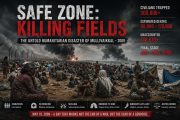
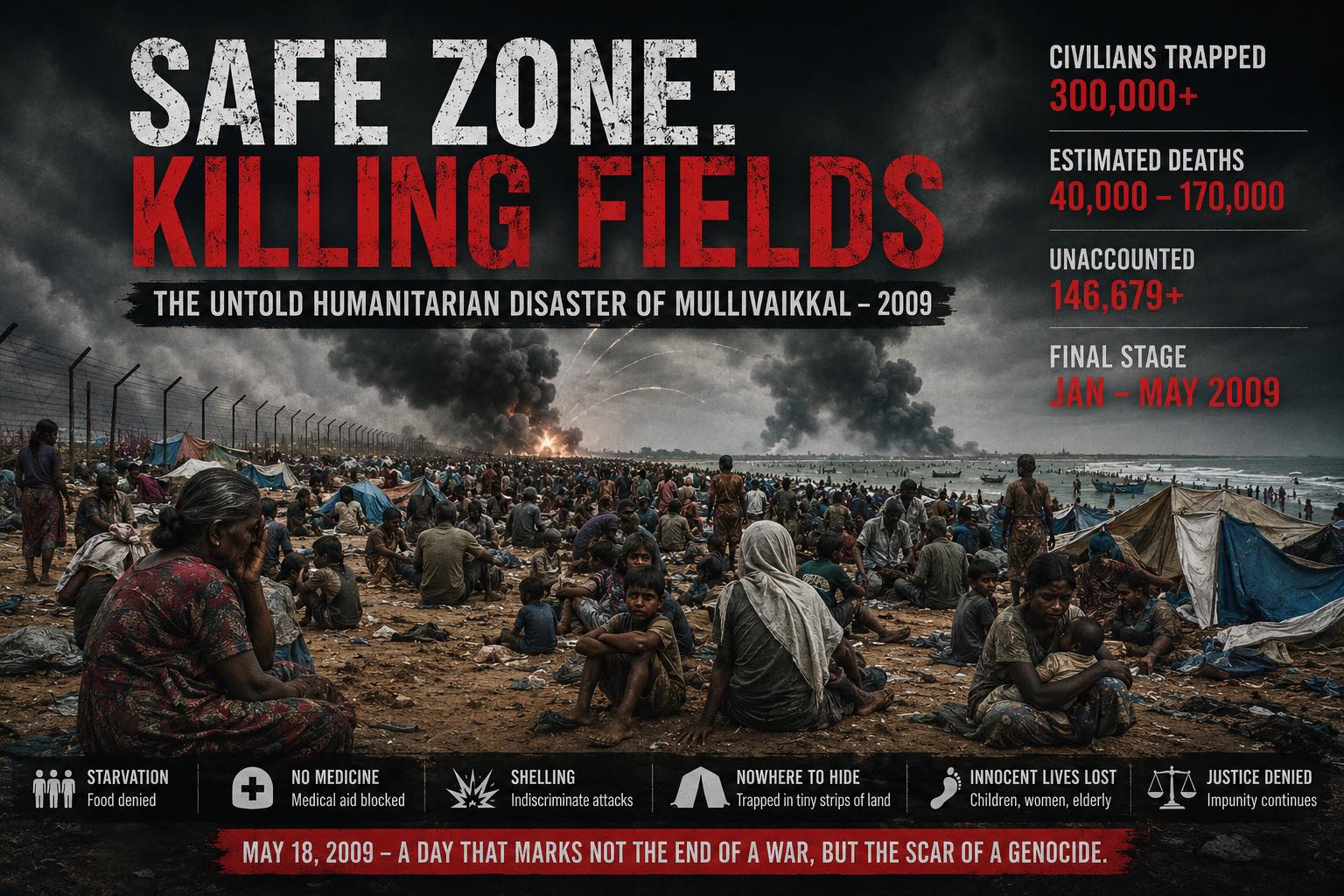
As the war reached its peak in 2009, despite the United Nations and local government officials indicating that more than 300,000 civilians were trapped inside the so-called “No Fire Zones,” the Sri Lankan government informed the world that only 70,000 civilians remained there. Based on this drastically reduced estimate, the amount of food sent during the war amounted to merely 15% to 20% of the actual requirement, which became one of the primary causes of the severe starvation and the tragic “kanji-thotti” (gruel queue) humanitarian disaster that unfolded there.
However, after the war officially ended in May 2009, between 280,000 and 300,000 civilians who emerged from the Vanni region and surrendered to the Sri Lankan military were officially registered in temporary welfare camps such as Menik Farm in Vavuniya. This final official statistic itself disproved the government’s wartime claims regarding the civilian population and demonstrated that nearly three times more people had been living in the region than the state had acknowledged.
The official report of the United Nations Secretary-General’s Panel of Experts estimated that at least 40,000 civilians may have been killed during the final stages of the war. After conducting a detailed analysis of the Sri Lankan government’s own census and statistical records, the Bishop of Mannar Diocese, Rt. Rev. Rayappu Joseph, officially revealed that 146,679 Tamils remained unaccounted for (either disappeared or killed). Subsequently, based on further witness testimonies and demographic analyses, the International Truth and Justice Project (ITJP) estimated that the total number of deaths could be as high as 169,796. Collectively, these figures demonstrate to the world that what occurred in Mullivaikkal was not merely the final chapter of a conventional war, but rather a systematically orchestrated human catastrophe.
The Sri Lankan Tamil genocidal war left behind deep humanitarian scars and immeasurable suffering. Hundreds of thousands of civilians became trapped within a narrow strip of land in Mullaitivu District. At that moment, the areas officially declared as “Safe Zones” or “No Fire Zones” for the protection of civilians did not become sanctuaries of safety; instead, according to reports by the United Nations and other international organizations, as well as direct battlefield testimonies, they transformed into the epicenter of a massive humanitarian catastrophe.
The Background and Circumstances Behind the Creation of the Safe Zones
During the latter part of 2008 and the beginning of 2009, as the war intensified in northern Sri Lanka, the territories controlled by the Liberation Tigers of Tamil Eelam (LTTE) rapidly shrank. Consequently, hundreds of thousands of civilians displaced from other parts of Kilinochchi and Mullaitivu districts were forced to retreat continuously in accordance with the shifting frontlines of war.
In early January 2009, amid the advancement of government forces and heavy artillery shelling, the Sri Lankan government and military declared certain designated areas as “Safe Zones” for civilians seeking refuge. However, these zones were not established as permanent protected spaces. Instead, they were repeatedly relocated within short periods according to battlefield movements and military strategies.
Terminologies and Names Used
During this period, international organizations, media institutions, the Sri Lankan government, and the military used the following major English terms and their Tamil equivalents:
* Safe Zone / Civilian Safety Zone: Civilian Protection Zone.
* No Fire Zone (NFZ): Zone where firing was prohibited (this later became the globally recognized term).
* Protected Area for Civilians: Protected civilian area.
* Humanitarian Operation Area: Humanitarian operation area.
The Three Main Phases of the Safe Zones
During the final five months of the war, the boundaries and locations of the Safe Zones changed through the following three major phases:
First Safe Zone (January 2009)
Location:
An area of approximately 35 square kilometers covering Udayaarkattu, Suthanthirapuram, and Visuvamadu in Mullaitivu District.
Context:
This zone was first declared by the military on January 21, 2009. Civilians were instructed via radio broadcasts and leaflets to move rapidly into the area, which was not under government military control. However, within days of its declaration, attacks were also reported inside this zone.
Second Safe Zone (February – March 2009)
Location:
The coastal regions of Puthumathalan, Valainjarmadam, and Irattavaikkal.
Context:
On February 12, 2009, a new Safe Zone was declared. Its area was significantly reduced compared to the previous one, becoming a narrow coastal strip. Due to the extremely high population density, civilians sheltered in temporary tents throughout the area.
Final Safe Zone (April – May 2009)
Location:
The coastal strip of Mullivaikkal and Vellamullivaikkal.
Context:
On April 08, 2009, the final Safe Zone was redefined. It consisted of only a few square kilometers. By mid-May, as the entire war contracted into this tiny area, hundreds of thousands of civilians remained trapped there without even the most basic forms of protection.
The Reality Inside the Safe Zones: International Reports and Testimonies from Traces of the Tamil Genocide
International documents such as the United Nations Panel of Experts Report (2011), along with eyewitness accounts, documented the following shocking realities inside the Safe Zones:
Zones Subjected to Attacks
Despite hundreds of thousands of civilians gathering there believing these were “No Fire Zones,” reports indicate that heavy artillery shelling, mortar attacks, cluster munitions, and incendiary weapons repeatedly struck these areas.
Life Inside Bunkers
To protect themselves, civilians were forced to remain day and night inside underground bunkers. In many instances, artillery shells directly struck these bunkers, burying entire families alive beneath the earth. Witness testimonies describe these horrific tragedies in painful detail.
Attacks on Temporary Hospitals and Civilian Gathering Points
As no permanent infrastructure existed inside the Safe Zones, humanitarian assistance and emergency medical treatment were conducted through temporary facilities.
Attacks on Hospitals:
Temporary hospitals functioning in places such as Puthumathalan, Valainjarmadam, and Mullivaikkal, as well as Red Cross distribution points, were repeatedly hit by shelling, killing numerous patients and civilians receiving treatment.
Emergency Surgeries Inside Bunkers
Despite severe shortages of medicine and anesthesia, local doctors continued their humanitarian service with extraordinary dedication, conducting emergency surgeries inside bunkers themselves. These acts of sacrifice are extensively documented in Traces of the Tamil Genocide.
Relief Shelters
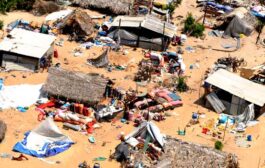
Due to the lack of proper housing, civilians were forced to live in makeshift shelters made of tarpaulin sheets and palmyra leaves.
Humanitarian Crisis and Civilian Suffering
The condition of civilians trapped inside the Safe Zones during the final phase of the war was beyond description.
Extreme Population Density
More than 300,000 civilians were forced to survive within an extremely small geographical area.
Food and Medical Shortages
Food supplies sent by organizations such as the World Food Programme (WFP) were grossly insufficient for the population trapped there. Witness testimonies describe how shelling attacks occurred even while civilians waited in long queues for a single meal of porridge.
Deaths Due to Starvation
Because food, clean drinking water, and medicines were severely restricted, many elderly people and infants died from malnutrition and deprivation.
Final Collapse: The Tragedy of May 2009
During the second week of May 2009, the military’s final advance toward Mullivaikkal reached its climax.
Collapse of the Safe Zone
Between May 15 and May 18, the final Safe Zone completely collapsed. Communications with international organizations and United Nations agencies were entirely severed.
Challenges Faced by Journalists
Journalists attempting to transmit the reality of conditions to the outside world faced immense obstacles and censorship. Despite these restrictions, records of the atrocities committed during those final days survived.
Civilian Death Toll
The United Nations Secretary-General’s Panel of Experts Report (2011) estimated that tens of thousands of civilians were killed during these final days. However, the exact number of civilians killed during the final stages of the war remains disputed to this day.
Surrender and Evacuation
On May 15, 16, 17, and 18, tens of thousands of surviving civilians entered military-controlled territory carrying white flags in surrender, after which they were detained in temporary welfare camps such as Menik Farm in Vavuniya.
Although the “Safe Zones” declared during the Sri Lankan war were officially established under the principles of International Humanitarian Law to protect civilians, the historical reality is that they ultimately failed to protect people from the horrors of war.
Whether these zones genuinely protected civilians or instead concentrated them into confined areas that facilitated mass destruction remains an unresolved debate among international legal experts and human rights organizations. Nevertheless, the combined evidence of battlefield testimonies and international reports reveals one undeniable truth: the humanitarian catastrophe that occurred in Mullivaikkal exposed the brutal face of war, and the very land declared a “Safe Zone” became a killing field soaked in the blood of thousands of innocent Tamil civilians. While the world remained silent in the name of humanitarianism, the rights, voices, and future of an entire people were systematically destroyed.
Even today, the wounds of that land have not healed, nor have those memories faded into silence. Yet despite the scale of the catastrophe and loss of life, the question remains unanswered before history: why does the international community still hesitate to explicitly recognize this as “Tamil Genocide”?
May 18 does not merely signify the end of a war; it stands as a dark and enduring chapter in human history — a permanent scar marking the destruction inflicted upon the Tamil people.
References
* United Nations (2011): Report of the Secretary-General’s Panel of Experts on Accountability in Sri Lanka.
* United Nations (2012): Report of the Secretary-General’s Internal Review Panel on United Nations Action in Sri Lanka (Petrie Report).
* Human Rights Watch (2009): War on the Displaced – Sri Lankan Army and LTTE Abuses in the Vanni.
* International Committee of the Red Cross (ICRC) (2009): Operational Updates and Field Press Releases on the Sri Lanka Conflict.
* Amnesty International (2009): Twenty Years of Make-Believe: Sri Lanka’s Commissions of Inquiry.
* Government of Sri Lanka (2011): Report of the Lessons Learnt and Reconciliation Commission (LLRC).
* International Crisis Group (2010): War Crimes in Sri Lanka (Asia Report N°191).
* BBC News & Reuters (2009): Archived Media Reports and Editorial Coverage on the Final Phase of the Vanni War.
* World Food Programme (WFP) & UNOCHA (2009): Joint Emergency Situation Reports on Food and Nutrition Security in Northern Sri Lanka.
* Nijanthan Nilavan: Traces of the Tamil Genocide (Volumes 1 & 2) – Direct journalistic records and battlefield testimonies.
Journalist & Counsellor